
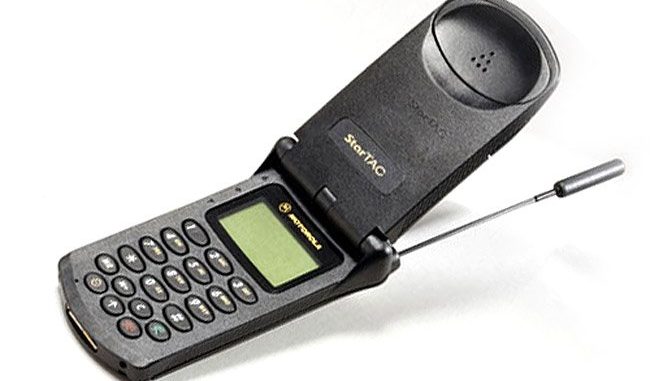
It is January 1996, and if you aren’t currently staring at the Motorola StarTAC with a mixture of lust and financial dread, you’ve clearly settled for a life of carrying a plastic brick in a holster. The StarTAC isn’t just a phone; it is a declaration that the “mobile” part of mobile telephony has finally arrived. For the staggering launch price of £1,400 in the UK, Motorola has essentially taken the existing MicroTAC, put it through a shrink-ray, and created the world’s first true clamshell.
The engineering here is nothing short of wizardry. At a mere 88 grams, it is the first handset to duck under the 100g barrier, making it comfortably the lightest phone on the market. To achieve this, Motorola had to rethink everything. While most of our current handsets are still lugging around heavy Nickel Metal Hydride (NiMH) batteries that have the lifespan of a Mayfly, the StarTAC offers an optional Lithium-ion cell. It’s a bit of a cheek that the slim battery only gives you about 60 minutes of talk time, but if you’re important enough to own this, you’re probably paying someone else to talk for you anyway. If you need more juice, you can clip an “auxiliary” battery onto the back, though this gives the phone a distinctive hump that ruins the otherwise sleek profile.
Technically, the StarTAC is a bit of a mixed bag depending on which network you’ve signed your life away to. The original StarTAC 8500 and 85 models are essentially high-end AMPS or ETACS handsets, while the digital GSM versions are trickling into the UK market for those on Orange or Vodafone. The display is where things get interesting, or frustrating, depending on your eyesight. The base StarTAC 3000 uses a segmented LED display that looks like a 1970s calculator, while the 8500 moves up to a dot-matrix LED that can actually handle alphanumeric characters. It’s bright enough to be seen from space but won’t show you much more than a single phone number at a time.
Then there is “VibraCall”. Finally, a phone that doesn’t have to scream at you. Having a silent vibration alert in your pocket is a revelation for anyone who spends time in meetings or anywhere else where a monophonic rendition of “The British Grenadiers” might be considered poor form.
However, let’s be real about the user interface: it’s a dog’s dinner. Navigating Motorola’s menu system feels like trying to solve a Rubik’s Cube in the dark. The buttons are tactile enough, but the logic behind “Function + 1” for various features is enough to make you long for the simplicity of a Nokia. And then there is the antenna, a flimsy, pull-out plastic stick that feels like it’ll snap if you so much as sneeze near it.
But you don’t buy a StarTAC for the menu system. You buy it because it fits in your top pocket without dragging your shirt down to your navel. You buy it because when you flip it open with a flick of the wrist, you feel like Captain Kirk calling the Enterprise. It is a masterpiece of miniaturisation that makes every other handset look like a piece of lab equipment. It’s expensive, it’s fiddly, and the battery is optimistic at best, but the StarTAC has just moved the goalposts for the entire industry.