
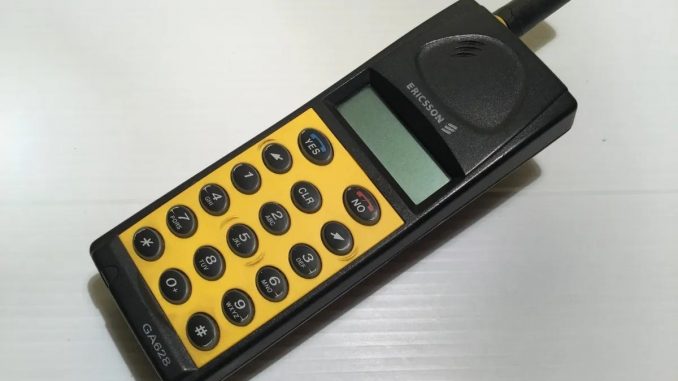
If the Nokia 9000 is a tailored suit, the Ericsson GA628 is a colourful shell suit for the masses. Launched in 1996 as a mid-range GSM contender, the GA628 is a sturdy, no-nonsense “brick” phone that has decided to inject a bit of fun into the grey world of telecommunications. Its big claim to fame is customisation. In a market where your choice of colour is usually “black” or “slightly darker black,” Ericsson has included four interchangeable plastic panels in the box, blue, green, red, and yellow, that slot around the keypad. You even get matching rings for the base of the fixed antenna. It’s the first time a mobile has felt like a personal accessory rather than a piece of office equipment.
Technically, the GA628 is fairly modest. It features a single-line alphanumeric display that can show 12 characters at a time, plus a row of fixed icons for things like signal strength and battery life. It runs on a 13 MHz Z80 CPU with 32 kB of RAM and 1 MB of flash memory for program code. There’s no clock, which is a bit of a baffling omission, and no games to speak of, but it handles the basics with Swedish efficiency. The interface is dominated by Ericsson’s “Yes” and “No” buttons, which make navigating the menus reasonably intuitive, provided you don’t mind a lot of scrolling to find your messages.
One of the GA628’s genuine strengths is its build quality and battery options. You can choose from several NiMH batteries, ranging from a “Slim” 500 mAh pack to a “High Capacity” 1200 mAh unit that makes the phone thick enough to use as a doorstop but provides up to 83 hours of standby time. It’s also surprisingly famous for its 007 connection, having featured in Tomorrow Never Dies, though sadly James Bond’s version had more gadgets than the retail model’s ability to send an SMS. For a few hundred quid on a standard Vodafone or Cellnet contract, the GA628 is a solid, reliable, and oddly charming little handset that proves you don’t need to spend a fortune to stand out in the pub.