
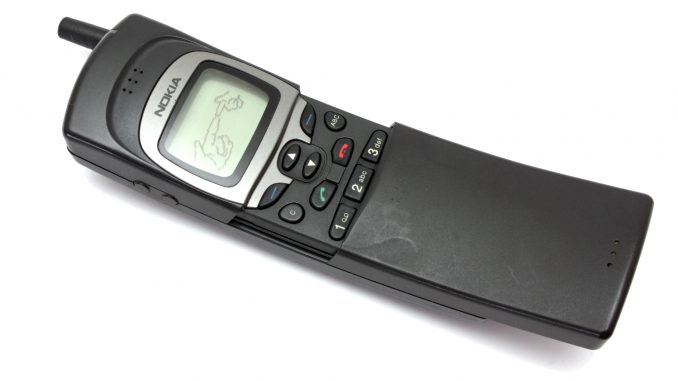
Released in the tail end of 1996, the Nokia 8110, affectionately dubbed the “Banana Phone” for its prominent curvature, is Nokia’s first real attempt at a premium, design-led handset. While the rest of the market is obsessed with making things smaller, Nokia has gone for “ergonomic,” which is Finnish for “it actually reaches your mouth”. Priced at roughly £700 on a UK contract, it’s a fair bit of money for what is essentially a very fancy plastic slide, but goodness, what a slide it is.
The mechanical action of the active slider is the 8110’s crowning achievement. You don’t just answer a call; you deploy the mouthpiece. Sliding it down reveals the keypad and automatically answers the line; sliding it shut terminates the call. It’s tactile, it’s satisfying, and it makes you feel like you’re living in a sci-fi thriller, even if you’re just calling the local chippy to see if they’ve still got any saveloys left. It’s worth noting that while the version used by Keanu Reeves in that upcoming Matrix film has a spring-loaded “popping” action, the actual retail model requires a manual thumb-flick. Still, it’s the coolest thing in the pub by a country mile.
Under the hood, the 8110 is the first phone based on Nokia’s new DCT2 platform. The display is a partially graphical monochrome dot-matrix that finally gives us a break from the “two lines of text” limitation of older handsets. It even has a row of fixed icons at the top for signal and battery, which is a nice touch for those of us who like to know exactly when our £700 investment is about to die. For the business types, it supports 9,600 bps data transfer with an add-on card, meaning you can, in theory, send a fax or a very slow email from a park bench.
The battery life is decent for the era, offering about 2 hours of talk time and nearly 30 hours of standby with the standard cell. If you’re really pushing it, you can opt for the high-capacity battery, though it turns the “Banana” into something more akin to a plastic eggplant. The sound quality is exceptional, largely because that curved slider brings the microphone right to your jawline, a bit of common sense that Motorola seems to have forgotten in their quest for miniaturisation.
There are some niggles. The antenna is still a fixed, protruding nub that likes to catch on the lining of your jacket, and the lack of Snake, yes, the game everyone is talking about, is a missed opportunity for a phone this expensive. But these are petty gripes. The Nokia 8110 is a design icon that feels like a tool from the next century. It’s heavy, it’s expensive, and it has a nickname that makes it sound like a piece of fruit, but it’s the most sophisticated bit of kit on the high street right now.