
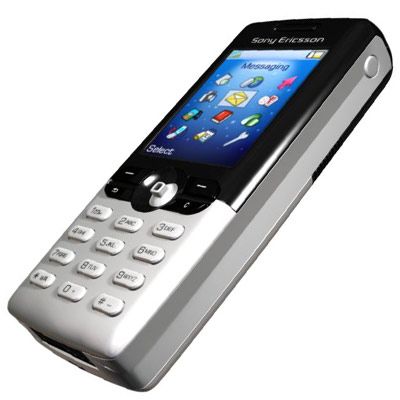
If the Samsung T100 was the flashy newcomer, the Sony Ericsson T610 is the sophisticated graduate who’s just walked in and taken over the room. Released in the UK in mid-2003, the T610 is the phone that finally validated the marriage of Sony and Ericsson. After a few “getting to know you” handsets like the T68i, they’ve finally produced something that feels like a singular, coherent vision. It is, quite simply, the most balanced and beautiful phone of its generation.
Design-wise, the T610 is a triumph. It’s a “monoblock” (or “candybar”) design that is split into two distinct halves: a brushed aluminium lower section and a high-gloss black upper section. It looks like it was designed by a high-end Swiss watchmaker rather than a telecommunications firm. It is tactile, it is weighted perfectly at 95g, and it feels incredibly robust. In an era where Nokia is experimenting with increasingly bizarre shapes (we’re looking at you, 3650), the T610 is a masterclass in elegant restraint.
Technically, it is packed to the rafters. It features a 65,536-colour STN display which, while not quite as punchy as Samsung’s TFT screens, is still a massive upgrade for most users. It has a resolution of 128 x 160 pixels, which is plenty for navigating the incredibly slick, icon-based menu system. This is where the “Sony” influence really shines; the UI is fluid, logical, and beautifully designed. It even includes a five-way joystick that makes navigation feel like playing a tiny video game.
The big news, however, is the camera. It’s a CIF-resolution (352 x 288 pixel) sensor tucked away on the back. By 2003 standards, this is cutting-edge. It even includes a tiny mirror next to the lens for taking “selfies”—a word we haven’t quite started using yet, but the T610 is definitely encouraging. Sony Ericsson has introduced “QuickShare,” which is more than just a marketing slogan; it’s a genuinely efficient way to take a photo and send it via MMS, email, or Bluetooth with just a couple of clicks. It makes the whole process of “mobile imaging” feel like a reality rather than a gimmick.
Connectivity is where the T610 really pulls ahead of the pack. It has Bluetooth, infrared, and GPRS. This is the “holy trinity” for the 2003 power user. You can sync your contacts and calendar with your PC without a cable, you can use it as a wireless modem for your laptop (if you’re brave enough to face the Orange data charges), and you can even send photos to other phones for free via Bluetooth. It’s a level of “joined-up thinking” that we’ve been craving for years.
The audio is also top-tier, featuring 32-polyphonic ringtones that sound rich and layered. It even includes an app called “MusicDJ,” which allows you to compose your own polyphonic tracks using a four-track sequencer. It’s the sort of thing you play with for three hours on a Saturday afternoon and then never touch again, but it’s a great technical showcase.
Is it perfect? Not quite. The screen is the T610’s one true weakness. Because it’s an STN panel rather than a TFT, it is notoriously difficult to read in direct sunlight. If you’re standing in a bright car park trying to read a text, you’ll find yourself shading the phone with your hand like you’re trying to keep a small fire going in the wind. There were also some early reports of “hissing” during calls on the first batch of handsets, but Sony Ericsson has largely sorted that out with firmware updates.
In the UK, the T610 has become the “standard-issue” phone for the ambitious professional. It’s the handset you see on every table in every gastropub in London. It’s professional enough for the boardroom, stylish enough for the club, and technically advanced enough for the hardest-to-please gadget nerd. It is the definitive “monoblock” phone, a device that feels like a finished product in a world of prototypes. If you own a T610 in 2003, you aren’t just making a call; you’re making a statement that you understand the future, and the future looks brilliant.