
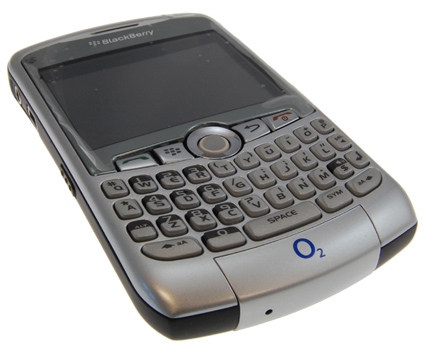
It is May 2007, and Research In Motion (RIM) has just performed a brilliant piece of corporate alchemy. They have taken the stern, grey-suited DNA of the BlackBerry and injected it with a dose of consumer-friendly fun. The result is the BlackBerry Curve 8300, and it is currently the most desirable object in the hands of everyone from City traders to creative directors in Soho. In the UK, this is the device that finally transitioned the brand from ‘business tool’ to ‘lifestyle accessory.’ It’s finished in a metallic ‘Liquid Silver’ with a rounded, pebble-like chassis that feels significantly more approachable than the slab-sided 8800. At 111g, it sits perfectly in the palm, and that iconic QWERTY keyboard—curved slightly to follow the arc of your thumbs—remains the gold standard for anyone who values words over emojis.nnTechnically, the Curve 8300 is a masterclass in focused engineering. The headline addition is the 2.0-megapixel camera with a built-in flash and a tiny ‘selfie’ mirror, marking the first time a ‘full’ BlackBerry has acknowledged that its users might actually want to take a photo of something other than a whiteboard. The camera interface is basic, but the shutter is responsive, and the image quality is surprisingly decent for a brand that usually treats photography as a frivolous distraction. The screen is a 2.5-inch landscape LCD with a 320 x 240 resolution, and while it lacks the vibrant saturation of a Samsung TFT, its light-sensing technology is world-class; it adjusts the backlight automatically to ensure the text is as readable on a sun-drenched platform at Waterloo as it is in a dimly lit bar.nnUnder the hood, the Curve is powered by a 312 MHz processor with 64MB of internal flash memory, but the real technical win is the inclusion of a microSD expansion slot and a 3.5mm headphone jack. This is a massive shift. You can now load up a 2GB card with MP3s, plug in your own Sennheisers, and use your BlackBerry as a legitimate music player. The ‘Media Player’ software is simple but effective, handling most formats with ease. However, the true soul of the device remains the trackball. This tiny, glowing pearl of translucent plastic allows for 360-degree navigation, letting you zip through your inbox or the browser with a fluidity that no D-pad can match. It’s a technical joy to use, even if we all know it’ll eventually get clogged with pocket lint and require a ‘vigorous cleaning’ with a bit of sticky tape.nnConnectivity is where the 8300 shows its age and its focus. It is a quad-band GSM/EDGE device, meaning it lacks 3G. In 2007, as the UK networks are aggressively pushing HSDPA, being stuck on EDGE feels like driving a Bentley with a lawnmower engine; the ‘push’ emails arrive instantly, but trying to load a complex website like the BBC News homepage is an exercise in Zen-like patience. There’s no Wi-Fi either, which is a stinging omission for a ‘connected’ device. Yet, because the BlackBerry OS is so incredibly efficient at data compression, it manages to feel faster than it has any right to be. The battery life is exemplary, with the 1100 mAh Li-Ion pack easily lasting two or three days of heavy ‘CrackBerry’ addiction. The Curve 8300 is the ultimate ‘bridge’ phone; it kept the corporate crowd happy while enticing a whole new generation of UK users who wanted the best typing experience on the market. It is a sober, reliable, and deeply addictive piece of Canadian engineering.