
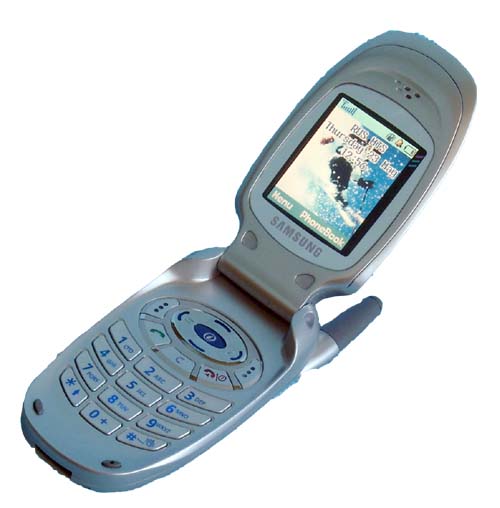
It is April 2002, and if you walk into any high-street mobile shop in the UK, you’re likely to see a crowd of people huddled around a small, silver, egg-shaped device. That device is the Samsung SGH-T100, and it is currently making every Nokia on the shelf look like it belongs in a black-and-white film from the 1940s. While we’ve been dutifully tapping away at our pea-soup green monochrome screens or squinting at the washed-out STN displays of the Ericsson T68, Samsung has essentially strapped a high-end television to a phone hinge and called it a day.
The headline act—the only act, really—is that screen. It’s a Thin Film Transistor (TFT) active-matrix LCD, and it is a revelation. It supports 4,096 colours at a resolution of 128 x 160 pixels, and it is so bright, so sharp, and so vivid that it genuinely startles people. For the first time, a mobile screen doesn’t just display information; it displays art. The pre-loaded wallpapers of tropical fish and mountain landscapes look better than the actual world outside a rainy window in Slough. This is the moment the mobile phone stopped being a communication tool and started being a multimedia entertainment device.
Technically, the T100 is a dual-band GSM 900/1800 handset, which is perfectly fine for the UK market but means you’ll be out of luck if you’re planning a business trip to the States. At 94g, it’s remarkably light for something that feels so premium. The clamshell design is quintessentially Samsung—smooth, curvaceous, and finished in a metallic silver that feels expensive. On the front, you’ve got a small monochrome sub-LCD that handles the basics: time, signal, and caller ID. It’s a sensible bit of engineering that prevents you from having to flip the phone open every five minutes, which is good, because the main screen is such a power-hog that it would probably drain the battery in forty seconds if it stayed on.
Speaking of batteries, Samsung has made a very interesting—and slightly worrying—decision. In the box, you’ll find two batteries: a slimline one that makes the phone look sleek but lasts about as long as a chocolate teapot, and a “high-capacity” one that adds a significant hump to the back of the device. This is a tacit admission from the engineers that 2002-era battery tech just isn’t ready for the “always-on” colour revolution. If you’re planning on using the T100 for anything more than a three-minute chat, you’d better carry the spare in your pocket like a high-tech survivalist.
The audio is another area where Samsung is showing off. The T100 features 16-chord polyphonic ringtones, which are a massive leap over the monophonic beeps and boops we’ve grown used to. When this thing rings with its pre-loaded rendition of Mozart or a pop melody, it actually sounds like music. It’s loud, it’s clear, and it’s the perfect way to let everyone on the bus know that you’ve got a phone that cost more than their monthly rent.
However, once you get past the jaw-dropping screen and the lovely audio, the T100 starts to reveal its limitations. The user interface is… well, it’s a bit basic. Compared to the intuitive Navi-Key system of a Nokia or the sophisticated menus of an Ericsson, the T100 feels a bit like using a very pretty calculator. There’s no GPRS, which is a baffling omission for a phone launched in 2002, and the WAP browser is strictly dial-up (CSD). This means that while you have this incredible screen, you can’t actually use it to browse the modern mobile web at any decent speed. You’re also stuck with 500 phonebook entries and no Bluetooth or infrared for easy file sharing. It’s a very beautiful, very expensive island.
But does any of that matter? Not really. In 2002, the T100 is a status symbol of the highest order. It’s the phone you see being used by the fashion elite in the West End. It’s a piece of jewelry that happens to make phone calls. Samsung has realised that the average consumer doesn’t care about data protocols or frequency bands; they care about how the phone makes them feel when they flip it open and the screen glows with the fire of a thousand suns. It’s a landmark device that has effectively fired the starting gun on the “screen wars,” and while it might be a bit of a “one-trick pony” technically, what a magnificent trick it is.