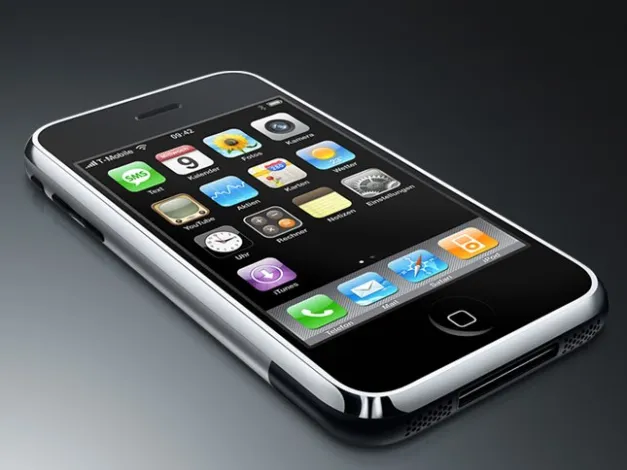

The date is November 9, 2007, and the queue outside the Apple Store on Regent Street has been growing for days. The iPhone has finally landed in the UK, exclusive to O2, and it has just made every other handset in the world look like a steam-powered tractor. It’s a slab of glass and aluminium with only one button on the front, and it has replaced the stylus and the keypad with the most advanced technical achievement in mobile history: a multi-touch capacitive display. At 3.5 inches and 320 x 480 pixels, the screen is a window into a different world. It’s not just a phone; it’s an iPod, a ‘breakthrough internet communicator,’ and a piece of high-art engineering that feels like it belongs in 2017, not 2007.nnTechnically, the ‘magic’ of the iPhone is the software-hardware integration. Running a version of Mac OS X (later iOS), it features ‘inertial scrolling’ and ‘pinch-to-zoom,’ gestures that feel so natural they instantly make the D-pads and joysticks of Nokia and Sony Ericsson feel archaic. It features a desktop-class web browser, Safari, which renders real websites, not the stripped-back WAP versions we’ve been suffering through. It’s got an accelerometer that flips the screen orientation automatically, an ambient light sensor, and a proximity sensor that turns the screen off when you hold it to your ear. It’s a suite of sensors that work in perfect harmony to create an experience that is entirely tactile and frictionless.nnHowever, for all its futuristic brilliance, the original iPhone has some startling technical gaps. It is a 2G (EDGE) device in a 3G world, meaning the internet speeds on the O2 network are glacial unless you’re on Wi-Fi. It doesn’t have GPS, it doesn’t support MMS, and the 2-megapixel camera is fixed-focus and lacks a flash—making it significantly worse as a camera than the year-old Sony Ericsson K800i. You can’t record video, and the Bluetooth is strictly for headsets, not for file sharing. Most annoyingly for UK users, the headphone jack is recessed so deeply that you need an adapter to use anything other than the included white earbuds. But these are the complaints of the old world. The iPhone has redefined the mobile phone as a software platform, and the technical bar for ‘usability’ has just been moved to another galaxy. It is the most influential bit of tech of the 21st century, a flawed masterpiece that has changed everything.
Apple iPhone