
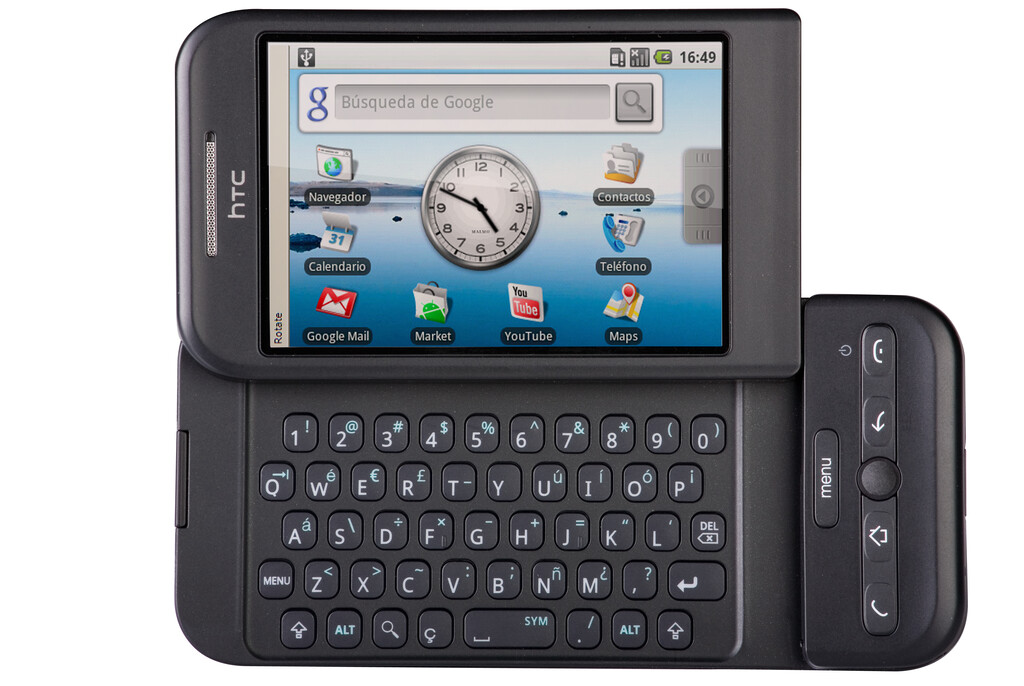
It is late 2008, and the mobile world has just felt its first major tremor of the Android revolution. The HTC Dream (launched in the UK as the T-Mobile G1) is a fascinating, slightly clunky pioneer that represents the world’s first commercial implementation of Google’s Android OS. For the British tech-enthusiast, this is the ‘anti-iPhone’, a device for the tinkerer who wants an open ecosystem rather than Apple’s ‘walled garden.’ It’s a slider with a ‘kick-out’ mechanism that reveals a full five-row QWERTY keyboard, and it features a trackball for navigation that feels like a nostalgic nod to the BlackBerry era. At 158g, it’s a substantial bit of kit, but that weight is the price of admission for the most customisable mobile experience on the planet.
Technically, the Dream is a playground for developers. It features a 528 MHz Qualcomm processor and a 3.2-inch capacitive touch screen with a 320 x 480 resolution. While the hardware design, with its prominent ‘chin’ housing the physical buttons, is a bit divisive, the technical integration of Google services is flawless. This is the first phone to feature the ‘Android Market,’ the direct rival to the App Store, and the first to show off the pull-down notification shade, a technical innovation so logical that every other OS has since copied it. It’s got a 3.15-megapixel autofocus camera, though, in a move that baffled the UK press, it lacks a standard 3.5mm headphone jack, requiring a clunky ExtUSB adapter for your tunes.
Connectivity is where the Dream earns its ‘G1’ moniker. It’s a 3G/HSDPA powerhouse with Wi-Fi, GPS, and a digital compass that enables a spectacular technical showpiece: the ‘Street View’ mode in Google Maps. When you move the phone, the view on the screen moves with you, a feat of sensor integration that feels like pure magic in 2008. The multitasking is a legitimate technical win over the iPhone; you can actually leave an app running in the background while you do something else. The battery life is, unfortunately, a bit of a nightmare. The 1150 mAh pack struggles to keep up with the ‘always-connected’ nature of the Google services, often dying before you’ve finished your evening commute. But for the technical pioneer, the HTC Dream is a rough diamond, the first step into a world that Google is about to conquer.
