

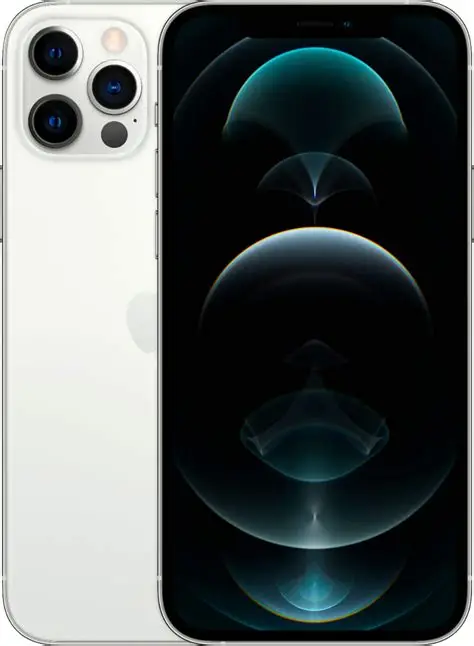
Released alongside its sibling in October 2020, the iPhone 12 Pro is a 187g technical showcase for Apple’s professional ambitions. Finished in surgical-grade stainless steel with a sophisticated ‘Pacific Blue’ matte glass back, it feels like a precision instrument. In the UK, it has arrived as the definitive choice for mobile creators and tech enthusiasts, introducing a world-first sensor for a smartphone: LiDAR. It is a dense, high-performance machine that marks the beginning of the computational ‘Pro’ era.
The technical headline is the LiDAR (Light Detection and Ranging) Scanner. By measuring how long it takes light to reflect back from objects, the 12 Pro can create a 3D map of your surroundings. This enables ‘Night Mode Portraits,’ near-instant autofocus in low light, and a massive leap in Augmented Reality (AR) accuracy. Powering this is the 5nm A14 Bionic and 6GB of RAM, 2GB more than the standard model, ensuring the device can handle ‘Apple ProRAW,’ a technical breakthrough that gives photographers the control of a RAW file with the benefits of computational photography.
The triple-camera array features improved lenses with an f/1.6 aperture on the main wide sensor, capturing 27% more light. The 6.1-inch Super Retina XDR display is brighter than the standard model, peaking at 800 nits in typical use. Connectivity is total with 5G, Wi-Fi 6, and the MagSafe system. It also features a higher IP68 rating, capable of surviving a 6-metre dunk for 30 minutes. The iPhone 12 Pro is a masterclass in professional-grade miniaturization; it took cutting-edge depth-sensing and silicon technology and put it into a design that remains one of the most beautiful in the history of the smartphone.
